How to Find a Plush Toy Manufacturer With Real Design Depth
Custom Plush Toy Manufacturing: Why Design Range Matters More Than Best-Sellers
When brands start sourcing custom plush toys, the first questions are usually about price and minimum order quantity. Design range rarely makes the shortlist.
After 18 years of custom plush toy manufacturing — working with toy brands, gift companies, and independent designers across 60+ countries — we’ve come to believe that design depth is one of the most underrated factors in choosing the right OEM manufacturing partner.
Here’s why.
Why Most Plush Toy Manufacturers Push Best-Sellers
It makes sense from a production standpoint. Fewer SKUs mean simpler material sourcing, faster sampling, more predictable output. A factory focused on five best-selling designs can run leaner and quote lower unit prices.
We’ve been asked about this approach more than once:
“You have 3,000+ designs. Why not simplify, focus on what sells, and scale up?”
The answer comes down to who our clients are — and what they actually need.
Why Different Markets Need Different Designs
Not one of our clients wants to sell the same product as someone else. And the differences between markets are significant enough that a single set of best-sellers simply can’t serve all of them well.
Europe — Buyers from the UK, France, Germany, and Scandinavia consistently look for fabric dolls and soft toys with an artistic, handcrafted aesthetic. Texture and material quality are scrutinized closely.
North America — US and Canadian gift companies prioritize strong character design and seasonal appeal. Products need to stand out on retail shelves and perform across multiple holiday categories.
Australia and New Zealand — Brands in this market tend toward nature-inspired animal designs, with strict compliance requirements under AS/NZS ISO8124 standards.
Japan — Japanese clients bring a completely different level of attention to proportion, facial expression, and finishing detail. Tolerances that would pass elsewhere often require revision here.
A manufacturer with a limited design library forces clients to compromise. A manufacturer with genuine design depth gives them a real starting point.
What 3,000+ Original Designs Actually Means for Your Brand
Our design library isn’t a catalog of variations on the same product. It spans fabric dolls, plush animals, character figures, seasonal collections, and decorative soft toys — each with its own construction, material specification, and aesthetic direction.
For brands sourcing custom plush toys, this matters in a practical way:
Faster development timelines. Starting from an existing design that’s close to your brief — and customizing color, size, embroidery, or branding — is significantly faster than developing from scratch. Sampling cycles are shorter. Revision rounds are fewer.
Lower development risk. Designs in our library have been sampled, refined, and in most cases produced at scale. The construction has been tested. The material combinations are known to work.
More distinctive end products. Clients who customize from our existing designs end up with products that feel original to their brand — without the cost and timeline of full bespoke development.
How to Use a Manufacturer’s Design Library Effectively
If you’re evaluating a custom plush toy manufacturer, here’s how to approach their design range:
Ask to see the full library, not just the highlights. A curated selection of twelve “hero” designs doesn’t tell you much about real range. You want to see whether the factory has genuine variety across product types, sizes, and aesthetics.
Look for designs close to your brief. You’re not looking for a finished product — you’re looking for a construction and aesthetic direction you can build from. A design that’s 70% of the way there is often more useful than starting from zero.
Ask what can and can’t be changed. Color, size, fabric, and embroidery are usually adjustable. Core construction — the pattern, the proportion, the way a garment is attached — is harder to change without effectively creating a new sample. Understanding these boundaries early saves time.
Request samples of modified designs, not just originals. The quality of a factory’s customization work is what you’re actually buying. Ask to see examples of existing designs that have been modified for other clients.
What Buyers Can Do With Our 3,000+ Plush Toy Design Library
For fast seasonal collections:
Start from existing plush toy structures and customize colors, fabrics, clothing, or embroidery.
For private label plush toys:
Add brand tags, custom hangtags, embroidery, packaging, and label details.
For lower sampling risk:
Use designs already tested in production instead of developing every pattern from zero.
What This Looks Like in Practice
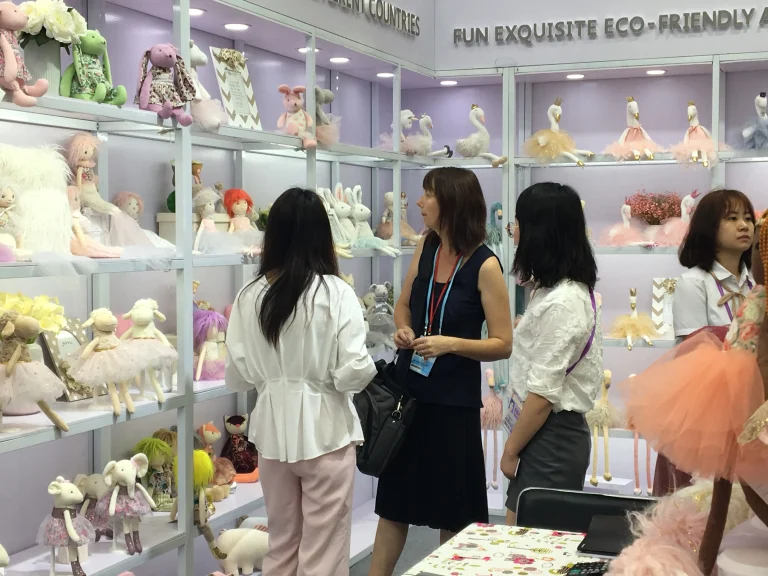
At trade shows, we watch the same thing happen repeatedly. A buyer walks our booth, picks up a design, puts it down, picks up another. They’re not looking for something nice — they’re looking for something that fits their brand.
The buyer who finds that fit in our booth leaves with a starting point for development. The buyer who doesn’t find it has to start from scratch elsewhere — or compromise on something that doesn’t quite work.
Design range isn’t a vanity metric. It’s a practical resource for the brands we work with.
About Mogomogo Plush/Grandfine
Grandfine is a plush toy and doll manufacturer based in China, with 18 years of experience supplying toy brands, gift companies, and independent designers across 60+ countries.
Key facts:
- 3,000+ original plush toy and doll designs
- OEM and ODM manufacturing available
- Safety certifications: EN71, ASTM, AS/NZS ISO8124, AZO FREE, REACH
- Export markets: Europe, North America, Australia/New Zealand, Middle East, Japan
- Minimum order quantity: from 20 pieces on existing catalog designs
If you’re sourcing custom plush toys or dolls and want to explore whether our design library is a fit for your brand, [contact us here] or visit [https://plushtoyswholesale.com].
Frequently Asked Questions
Why does design range matter when choosing a plush toy manufacturer?
A manufacturer with a large original design library gives you a practical starting point for custom development — reducing sampling time, development cost, and production risk compared to building from scratch.
How do I find a plush toy manufacturer with good design variety?
Ask to see the full design library, not just a curated highlights page. Look for genuine variety across product types, sizes, and aesthetics — and ask to see examples of how existing designs have been customized for other clients.
What is the minimum order for custom plush toys?
For existing catalog designs with customization (color, size, branding), minimum orders can start from 20 pieces. Fully bespoke designs requiring new pattern development typically require higher minimums.
Does a plush toy manufacturer in China need safety certifications?
Yes — any manufacturer supplying to the EU, US, Australia, or other regulated markets should hold current certifications including EN71, ASTM, AS/NZS ISO8124, and AZO FREE compliance. Always request documentation before placing an order.
How long does custom plush toy sampling take?
Sampling from an existing design typically takes 7–15 days depending on complexity. Full bespoke development from a new brief takes longer — usually 3–4 weeks for an initial sample.
Looking for a custom plush toy manufacturer for your next collection?
Send us your sketch, reference photo, moodboard, or product idea. Our team can help you evaluate whether to start from an existing design, modify a catalog style, or develop a fully bespoke plush toy sample.
Request OEM/ODM Plush Toy Development
Send Your Plush Toy Brief
Explore Custom Plush Manufacturing